Before you try to connect another person to an issue in the world that needs fixing- like hunger, environmentalism, school reform, or the economy- it is vital to ensure they are connected within themselves.
The Personal Engagement Institute has uncovered this important reality over the last 25 years. Working with young people from extremely disadvantaged backgrounds in a lot of different settings, we found that the kids who had lasting connections to what mattered most to them were able to form deep connections to the world around them.
We call these lasting connections within ourselves personal engagement. Personal engagement is about sustainability, choices, and when we want, becoming aware of the choices we make again and again.
Connecting With Our Self
A person who has felt a lifelong deep need to write poetry is personally engaged in poetry. When a person is trying to raise funds to support my nonprofit organization, they want to do more than simply squeeze $10 dollars from this poet.
Instead, we want to form a lasting connection between them and my nonprofit, and in the course of their giving experience we want them to see their gradual donations increase while becoming personally engaged with the success of the young people we work with. In order to do that, we need to find out what that donor is already personally engaged with, such as poetry. Once we find that out, we can find a connection between poetry and serving youth.
Between those points, we will work to nurture that relationship. But when we find a point when participants in my program are learning about free form poetic verse, perhaps we invite this donor to give a reading, or sit in class, or individually coach the learners.
Connecting With Our World
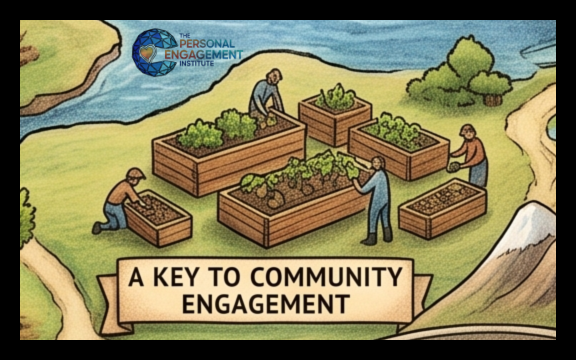
Whatever way we approach it, we have leveraged that person’s personal engagement in order to support their community engagement. Community engagement are the sustained connections a person has to the world around their self.
This approach is essential if we want to create lasting connections with people, no matter what your field, activity, issue, or outcomes.
If you are a parent who wants your children to engage within your house and family, find out what they care about and tap into that. If you are a teacher who wants to reach your students more effectively, identify what they’re personally engaged in and connect through that.
Personal engagement is the key to community engagement, whether with adults or young people.
6 Ways to Build Community through Personal Engagement
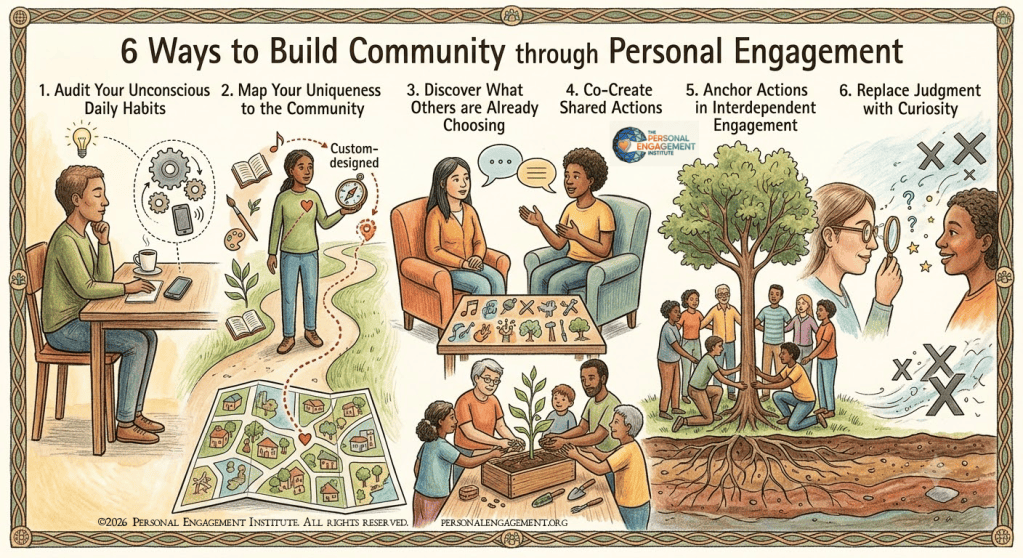
Here are 6 actions everyone can do to support communities through personal engagement:
1. Audit Your Unconscious Daily Habits
Before attempting to change the world outside, bring active awareness to your own daily rituals. Notice where you are choosing the same routines unconsciously (e.g., mindless scrolling, default social media watching, etc.) and deliberately pause. Flipping this internal switch from “OFF” to “ON” prepares your engine for meaningful community contribution.
2. Map Your Uniqueness to the Community
Identify what you already choose over and over out of pure authenticity—whether it is a hobby like poetry, a technical skill, or a specialized body of knowledge. Once you locate this personal anchor, intentionally look for a bridge where this specific passion intersects with a local need, converting individual joy into collective growth.
3. Discover What Others are Already Choosing
When inviting neighbors, youth, or colleagues to support a local cause, stop trying to force immediate buy-in. Instead, ask powerful questions to uncover what they are already engaged in. Recognize that to engage them in something new, you must first understand what they need to disengage from.
4. Co-Create Shared Actions
Sustained community engagement requires consistent conscious maintenance. Establish small, predictable, and repeatable practices within your neighborhood or group—such as a monthly mutual aid cleanup, regular storytelling circles, or shared weekly meals. These consistent points of contact turn individual moments of connection into a reliable, shared social fabric.
5. Anchor Actions in Interdependent Engagement
Shift your perspective from isolated self-interest or transactional volunteering to a deep awareness of interdependence. Recognize that every local action—whether voting consciously, supporting a neighborhood space, or offering mutual aid—branches out into a larger ecosystem that directly alters the trajectory of the entire community.
6. Replace Judgment with Curiosity
When community members seem detached, disengaged, or cynical, resist the urge to judge or criticize. Approach the situation with discernment, treating their apparent lack of engagement as a puzzle to solve rather than a perfection standard to meet. Dig deeper to find where their internal driver has stalled, and help them uncover a better alternative.
The Personal Engagement Institute shares learning opportunities, resources and more! Want to learn more?
« Tip Sheet 16 | Tip Sheet 18 »
Learn On Your Own…